

NVR vs DVR what is the difference
In the rapidly evolving digital landscape of Madhya Pradesh, choosing the right security infrastructure is a foundational decision for any enterprise. Business owners across the region frequently ask, “NVR vs DVR what is the difference?” and how this choice impacts their long-term operational security.
Lifeguard Data Recovery serves as the bridge between complex surveillance technology and practical business continuity. Consequently, we provide the hardware expertise to set up these systems and the forensic capability to rescue your critical evidence when disaster strikes.
Whether you manage a retail showroom in MP Nagar or a high-security industrial plant in Mandideep, your recorder choice determines your response to security threats. Furthermore, a misunderstanding of these technologies can lead to dangerous blind spots or poor image resolution.
As a result, it might result in total surveillance data loss during a crucial legal investigation. Our mission ensures that every business in Bhopal has access to high-tier technical clarity. Therefore, we offer the most reliable data recovery support in Central India through our dedicated local portal.
Resilient Hardware for the Bhopal Climate
Choosing the right recorder involves a deep dive into how data moves from the lens to the hard drive. Since Bhopal experiences unique environmental challenges, including high summer temperatures and significant electrical fluctuations, your hardware must be resilient. For this reason, we view these devices as the digital vaults of your business’s history rather than simple consumer electronics.
If a power surge hits your facility, the recorder’s internal architecture dictates whether you can salvage corrupted files. Meanwhile, our expert engineers in Bhopal provide 24/7 support to ensure that your “digital eyes” never fail. By choosing a partner that understands forensic data, you gain security that standard installation companies cannot provide.
Local Support for Madhya Pradesh Enterprises
Trust is the most valuable commodity in the security industry. When you partner with Lifeguard, you work with a team physically present in the Bhopal community. Specifically, we understand the local infrastructure and the common power grid issues in areas like Arera Colony. We also cater to the specific needs of Madhya Pradesh’s B2B sector.
This local presence allows us to offer rapid response times. If your system goes down, every hour of lost footage increases your vulnerability. However, we minimize that risk through proactive maintenance and rapid-response recovery protocols. We treat your video data with the same care and confidentiality as financial records. In addition, our secure lab in Bhopal handles sensitive B2B data under strict NDAs.
Get a System Consultation Today 24/7 Support | Secure Lab | Expert Engineers | 100% Confidential
Bhopal’s Trusted Experts in NVR vs DVR Comparison and Recovery
Navigating a professional NVR vs DVR comparison requires looking past surface-level features. You must understand the underlying data protocols. Digital Video Recorders (DVR) have been the industry standard for decades. Usually, they utilize analog signals converted at the recorder. On the other hand, Network Video Recorders (NVR) represent the modern shift toward IP-based digital streaming.
At Lifeguard, we help Bhopal business owners evaluate which system fits their existing cabling. We also consider future scalability needs. We believe that an informed client is a secure client. Therefore, we explain how these technologies interact with your local network. Our expertise is born from years of forensic experience.
Forensic Depth in CCTV Restoration
We often act as the last line of defense when a DVR failure occurs. While an installation company might say your data is gone after a short-circuit, our engineers look deeper. For instance, we analyze the proprietary file systems used by brands like Hikvision and CP Plus. We then manually reconstruct video streams.
This technical depth makes Lifeguard the leading authority in the Bhopal region. We compare the survivability of your data under real-world stress conditions rather than just comparing specs. Moreover, our team can handle physical repairs that most standard IT shops would avoid.
The Evolution of Surveillance in India
Surveillance technology in India now goes beyond simple monitoring. Businesses use it for inventory management and employee safety audits. Consequently, the difference between NVR and DVR has become even more pronounced. In Bhopal’s competitive market, a system supporting high-definition analytics provides a significant edge.
In addition, we help you choose a system that grows with your business. This ensures your initial investment continues to pay dividends as you expand operations. By focusing on scalability, we protect you from early hardware obsolescence.
Strategic Planning for Industrial Upgrades
In many older industrial sectors of Bhopal, existing coaxial infrastructure makes a DVR setup logical. However, we guide modernizing businesses through hybrid solutions. This allows for a gradual transition to NVR technology.
Strategic planning prevents the “rip and replace” scenario that drains IT budgets. By understanding the surveillance roadmap, we ensure your Bhopal enterprise remains protected by the best tools available. Furthermore, we provide on-site training to your security staff during these transitions.
Specialized CCTV Recovery Lab
When a hardware disk crash happens, it compromises the physical integrity of the storage media. This highlights the distinction between a repair shop and our specialized recovery lab. At Lifeguard, we maintain a controlled environment in Bhopal where we safely open hard drives to perform mechanical repairs.
If a fire or flood damages your recorder, standard recovery methods will fail. Therefore, our cleanroom technicians transplant damaged read/write heads and stabilize platters to extract raw data. This forensic capability ensures your business has a path back to stability even in worst-case scenarios.
Comprehensive IT Support: CCTV, Data Recovery, and Laptop Repair
Lifeguard Data Recovery provides a holistic approach to B2B IT services. We recognize that technology is interconnected in a modern office. For example, a single electrical event in a Bhopal commercial complex can trigger a laptop failure and a server crash simultaneously. Because our expertise spans across data recovery and surveillance systems, we address the root cause of these issues at once.
Motherboard and Component Repair
Our laptop repair services in Bhopal focus on component-level diagnostics. Instead of replacing an entire costly motherboard, we use micro-soldering to fix specific motherboard issues. This technical precision mirrors our approach to data recovery. Consequently, we fix what is broken while preserving the rest of your investment. Whether it is a monitoring workstation or a critical laptop, we restore your hardware to peak performance.
CCTV Installation & Maintenance
Preventative maintenance helps you avoid surveillance data loss. Our installation teams in Bhopal focus on “future-proofing” your setup. We use high-quality, shielded cabling to reduce signal interference. In addition, we ensure every recording unit sits in a ventilated, secure environment. Regular maintenance checks by our engineers identify failing hard drives before they completely crash.
Climate-Specific Maintenance
This proactive approach is vital in Bhopal’s climate. Since dust accumulation often leads to fan failures and processor overheating, we include physical cleaning in our packages. We also perform firmware updates and storage health audits. This gives you peace of mind that your evidence records correctly every single second.
The Fundamental Difference Between NVR and DVR Systems
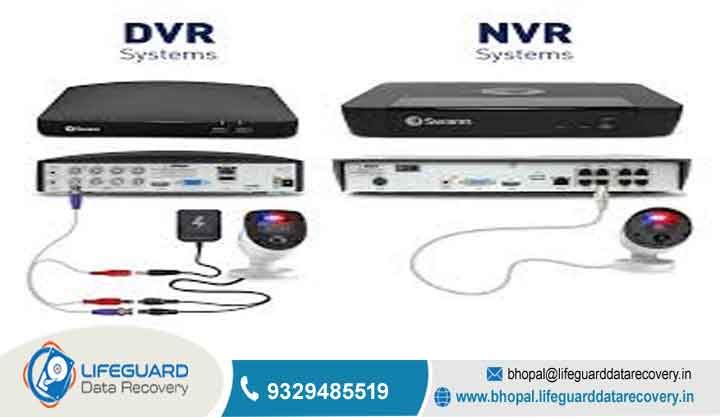
To truly understand the difference between NVR and DVR, you must look at video signal processing. In a DVR system, the processing happens at the recorder itself. The cameras are “dumb” devices that capture light and send it via coaxial cable. Then, the DVR converts this analog signal into a digital format. While this is a proven technology, cable quality often limits it.
For many small businesses in Bhopal, a DVR remains a reliable entry point. However, as the need for detail grows, analog signal limitations become apparent. Analog cables are prone to “noise” from electrical lines, which causes flickering. In a high-interference environment like a factory, this can render your security footage useless.
DVR (Digital Video Recorder)
The DVR is the backbone of traditional analog surveillance. It uses BNC connectors and coaxial cables to link cameras. Modern HD-Analog DVRs can provide impressive 5MP or 4K resolution. However, the thick cabling is difficult to install in older buildings. Furthermore, the signal can degrade if the cable run is too long.
Despite these limitations, the DVR remains a stable platform for many. It offers a “plug and play” simplicity that local business owners appreciate. Since the cameras lack their own IP addresses, they are immune to network-based hacking. This provides inherent isolation for localized security needs.
NVR (Network Video Recorder)
The NVR is a specialized computer that sits on your network. It communicates with IP cameras via a network switch. This flexibility is its greatest strength. You can place cameras anywhere there is a network port. Consequently, this makes it much easier to expand your system as your Bhopal business grows.
Moreover, the digital signal ensures the quality at the camera is exactly what gets recorded. The NVR is almost always the choice for high-security applications. Because each IP camera is its own computer, they can perform “edge analytics.” They handle motion detection before the data reaches the recorder, which reduces the load on the system.
Managing Your DVR vs NVR Security System Infrastructure
Maintaining a DVR vs NVR security system requires a dedicated approach to storage. Surveillance systems are unique because they are “write-intensive.” They write data to the disk 24 hours a day. This puts an immense strain on hard drives. In Bhopal, where dust and heat stress these components, choosing the right storage media is critical.
We only use surveillance-grade drives rated for constant operation. Using a standard desktop drive in a recorder is a leading cause of surveillance data loss. Desktop drives are designed for light workloads, whereas surveillance drives optimize for continuous video data. By ensuring the correct hardware is inside your recorder, we extend the life of your system.
Advanced Storage Solutions
We implement advanced RAID configurations for our enterprise clients in Bhopal. RAID allows your system to continue recording even if a hard drive fails completely. This redundancy is the ultimate insurance policy against a disk crash. If a drive fails in an NVR system, our team can swap it out and rebuild the data array without the system going offline.
This enterprise-grade management is why Lifeguard is the preferred IT partner for the local B2B sector. We also help businesses set up “Hot Spare” drives. These disks take over the recording task automatically if a failure occurs. This “zero-downtime” philosophy is essential for high-security environments like jewelry stores or financial centers.
Securing Data in Harsh Environments
Bhopal’s industrial areas can be harsh on electronics. Fluctuating voltage and industrial vibration lead to premature hardware failure. For this reason, we provide ruggedized enclosures and specialized mounting solutions to protect your NVR or DVR. By shielding the heart of your security system, we reduce repair frequency and ensure a stable environment.
We also recommend Solid State Drives (SSDs) for the recorder’s operating system. Meanwhile, we keep high-capacity mechanical drives for video storage. This hybrid approach ensures the system stays fast and responsive. It manages terabytes of historical footage while providing a snappy interface for your security personnel.
NVR vs DVR What is the Difference When Failure Occurs?
When a system stops recording, the immediate question is: “NVR vs DVR what is the difference in how we fix it?” In a DVR system, failures are often hardware-based, such as a blown power supply. Because the system is simpler, we can often repair these quickly. However, in an NVR system, failures are often network-related. For example, an IP conflict can take your entire camera array offline.
Our engineers solve these issues regardless of the platform. If the internal hard drive fails, the recovery process also differs. DVRs often use a linear file system that our forensic tools can “carve” easily. Conversely, NVRs use complex, packetized data structures that require advanced reassembly. If you face a DVR failure and the files appear as corrupted files, do not run “repair” software.
Resolving Connection Issues
Many businesses in Bhopal struggle with “ghosting” in analog systems or “lag” in IP systems. These are usually symptoms of poor infrastructure. In a DVR setup, ghosting is often caused by low-quality cables or interference. In an NVR setup, lag usually signals a bottlenecked network switch. Therefore, we perform a full signal audit to identify these issues.
Our goal provides a crystal-clear image. We ensure your footage is useful when you need to identify a face. This often involves re-terminating connectors or upgrading to shielded Cat6 cabling. By cleaning up the “signal path,” we ensure your recorder receives a high-quality stream. This leads to better compression efficiency and longer storage retention times.
Expert Advice: NVR vs DVR Which is Better for Data Security?
When a client asks, “NVR vs DVR which is better for data security?” we look at physical security and cybersecurity. Physically, an NVR can be hidden in a server room far away from the cameras. This makes it harder for an intruder to find and destroy it. Digitally, NVRs offer better encryption and user management. Consequently, you can give different access levels to different employees.
This makes the NVR the superior choice for modern Bhopal businesses prioritizing data privacy. However, the “air-gapped” nature of a traditional DVR can be an advantage. Because many DVRs do not connect to the office network, they are immune to remote hacking. For a business in Bhopal wanting a simple, localized security system, a DVR remains a very secure option.
Common Questions: NVR vs DVR What is the Difference?
What is the main difference between NVR and DVR cabling? The primary difference between NVR and DVR cabling is the type of wire used. DVRs use bulky coaxial cables that carry only video. On the other hand, NVRs use standard Ethernet cables. These are thinner and carry both data and power using PoE technology. Consequently, this makes NVR installations much cleaner for Bhopal businesses.
In an NVR vs DVR comparison, which offers higher resolution? In a direct NVR vs DVR comparison, the NVR consistently offers higher resolution. Modern analog systems can reach 4K, but they often suffer from signal degradation. In contrast, NVRs handle digital IP streams, which maintain clarity regardless of cable length. Therefore, if you need to identify small details, the NVR is the superior choice.
How do I fix a DVR vs NVR security system that isn’t recording? If your DVR vs NVR security system stops recording, check the health of your storage media first. Most recorders have a “HDD Status” menu. If it shows an error, your hard drive may have failed. Turn the unit off immediately. Continued use can overwrite existing data. Contact Lifeguard in Bhopal via our website for professional help.
For 4K cameras, NVR vs DVR which is better? For high-bandwidth 4K video, the “NVR vs DVR which is better” answer is almost always NVR. 4K analog signals require specialized cables and are prone to interference. However, NVRs are built for digital data, making them much more reliable at handling massive information. For any new high-resolution installation, we recommend an NVR system.
Can you recover deleted footage from an NVR? Yes, we can often recover deleted data from an NVR, but success depends on timing. NVRs use a “circular buffer,” meaning they eventually write new footage over the old. If you stop the system immediately after the deletion, recovery chances are high. Our Bhopal lab uses specialized forensic software to find these orphaned video blocks.
Secure Your Business with the Best NVR vs DVR Comparison Expert
Making the right choice in your NVR vs DVR comparison is the first step toward a secure business environment. Do not wait for a security breach or hardware failure to act. Our Bhopal-based team is ready to audit your current setup. Furthermore, we provide the necessary upgrades to keep your data safe.
The security of your assets in Madhya Pradesh depends on the reliability of your data. Trust Lifeguard Data Recovery to provide technical expertise and forensic precision. Whether you need a new installation or emergency help after a surveillance data loss, we are just a phone call away.
Call Now: +971 123 456 78
Visit Website: http://bhopal.lifeguarddatarecovery.in