
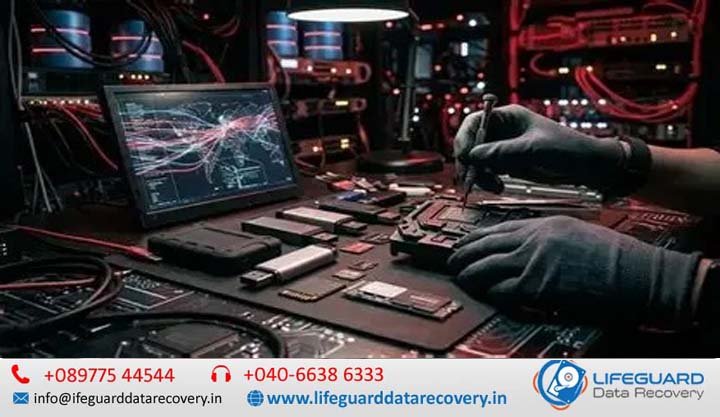
The loss of sensitive corporate files, customer database records, or financial statements can paralyze an enterprise. In India’s fast-evolving digital landscape, media failure or accidental deletion involves more than just a technical hurdle; it introduces severe regulatory exposure, potential operational downtime, and legal liability.
When dealing with sensitive intellectual property or personally identifiable information (PII), handling storage media requires strict technical protocols. Standard consumer data recovery tactics can inadvertently trigger permanent data overwrites or expose sensitive files to unauthorized third parties.
This guide details the technical mechanisms, legal obligations, and emergency procedures required for data recovery for confidential data India, ensuring full operational compliance and complete file integrity.
What are Secure Data Recovery Services India & Private Data Recovery India?
Selecting secure data recovery services India requires distinguishing between basic consumer file un deletion and enterprise-grade private data recovery India. While standard software recovery focuses on basic file system unformatting, private enterprise retrieval prioritizes absolute data isolation, non-disclosure protocols, and non-destructive extraction.
Understanding the Pillars of High-Security File Retrieval
To guarantee the secure recovery of sensitive business data, professional laboratories operate under strict physical and digital isolation protocols:
-
Air-Gapped Workstations: Recovery hardware is completely disconnected from internal networks and the public internet, preventing external exfiltration during raw sector extraction.
-
Hardware Write-Blockers: Specialized physical controllers allow read-only access to source media, ensuring metadata, access timestamps, and damaged sectors remain completely unaltered.
-
Encrypted Bit-Stream Cloning: Technicians never work directly on original source media. Instead, an exact bit-level clone is extracted to an encrypted target drive before analytical extraction begins.
India’s Legal Framework: DPDP Act 2023, IT Act 2000, and Vendor NDAs
Outsourcing media containing corporate data to external vendors requires strict compliance with India’s legal frameworks. Under the Digital Personal Data Protection (DPDP) Act 2023, organizations function as Data Fiduciaries responsible for safeguarding personal records. Handing over media to a third-party lab makes that vendor a Data Processor.
Section 8(5) of the DPDP Act 2023 mandates that failure to implement reasonable security safeguards against data breaches carries civil penalties of up to ₹250 crore per instance. Consequently, any third-party recovery engagement involving secure recovery of customer information must be bound by a comprehensive Data Processing Agreement (DPA) and a legally enforceable Non-Disclosure Agreement (NDA) compliant with Section 43A of India’s Information Technology Act, 2000.
Primary Causes Leading to Lost Confidential Files Recovery India
Understanding the underlying failure modes helps IT teams choose the correct recovery path for lost confidential files recovery India.
Human Error, Accidental Formatting, and Malware Attacks
Logical failures occur when physical media remains healthy, but internal directory structures are corrupted:
-
Confidential Data Recovery After Accidental Formatting: Fast-formatting creates new file system tables (e.g., NTFS, EXT4, APFS) while leaving raw data blocks intact until overwritten.
-
Confidential Data Recovery After Partition Loss: Corruption in the Master Boot Record (MBR) or GUID Partition Table (GPT) renders volume headers unreadable, marking valid storage blocks as unallocated space.
-
Ransomware Encrypted Volumes: Complex cryptographic attacks compromise logical access, requiring specialized shadow volume extraction or decryptor integration without altering master file tables.
Storage Media Corruption and Mechanical Drive Crashes
Hardware failures stem from physical damage to components:
-
Read/Write Head Assembly Breakdown: Physical shock causes drive heads to contact rotating platters, creating physical scoring and surface corruption.
-
Solid-State Controller Failure: Flash controller firmware corruption or degraded NAND blocks prevent drive initialization, causing the media to report as uninitialized or display incorrect capacities.
-
Power Surges & PCB Corruption: Voltage spikes damage Printed Circuit Boards (PCBs) and TVS diodes, preventing power from reaching internal spindle motors or memory chips.
Recognizing Storage Failures: Hard Drive Data Recovery India & SSD Data Recovery India
Identifying device failure symptoms early prevents permanent media destruction during hard drive data recovery India and SSD data recovery India.
| Diagnostic Criteria | Mechanical Hard Disk Drives (HDDs) | Solid-State Drives (SSDs & NVMe) |
| Physical Warning Signs | Repeated clicking, grinding, or high-pitched whining motor sounds. | Sudden device disappearance, blue screen of death (BSOD), read-only file system locking. |
| OS Behavior | Extreme read latency, freezing during file access, raw file system prompt. | OS fails to detect drive in BIOS/UEFI; drive displays incorrect capacity (e.g., 0 MB or SATAFIRM S11). |
| Primary Failure Point | Mechanical head assembly, spindle bearings, platter surface scoring. | Flash controller failure, NAND degradation, power management IC breakdown. |
| Time-Sensitivity | High (continued power degrades mechanical platter surfaces). | Critical (TRIM commands actively wipe deleted memory blocks in the background). |
Hardware Symptoms in Workstations: Laptop Data Recovery India
Laptops face distinct environmental risks such as drop impacts, thermal throttling, and liquid contact. When managing laptop data recovery India, key symptoms include operating system boot loops, clicking sound patterns, and SMART error warnings (such as Reallocated Sectors Count or Uncorrectable Sector Count). In these scenarios, power down the laptop immediately to avoid aggravating surface platter damage.
Critical Enterprise Failure Symptoms: Server Data Recovery India & RAID Data Recovery India
For enterprise server infrastructure, data loss can affect hundreds of users simultaneously:
-
Server Data Recovery India: Failed host bus adapters (HBAs), virtual machine disk corruption (VMDK/VHDX), and unmountable file systems require raw virtual volume reconstruction.
-
RAID Data Recovery India: Degraded or double-degraded array states (RAID 5/6/10) cause server collapse. Parity desynchronization demands specialized virtual array reassembly before extracting file systems.
-
Confidential Database Recovery Services India: Relational database management systems (Oracle, MS SQL, MySQL, PostgreSQL) can suffer corrupted transaction logs or damaged
.mdf/.dbffiles, requiring sector-level page repair to restore database integrity.
Step-by-Step Protocol for Deleted Confidential Data Recovery India
Executing an emergency protocol prevents permanent file overwrites and avoids security compliance gaps during deleted confidential data recovery India.
1.Immediate System Containment and Media Isolation:Halting write operations and disabling background processes.
Safely power down the affected machine or unmount the storage volume. Never install recovery software on the drive containing lost data.
If handling SSDs, immediately execute system shutdown to stop the operating system from sending background ATA TRIM commands, which permanently wipe deleted NAND blocks.
2.Vendor Vetting and Compliance Verification:Auditing physical security, certification, and legal frameworks.
Verify that your chosen recovery provider operates an ISO 5 (Class 100) cleanroom for physical repairs and maintains ISO/IEC 27001 information security certification.
Execute a mandatory Non-Disclosure Agreement (NDA) and Data Processing Agreement (DPA) containing explicit indemnification clauses before shipping source media.
3.Cleanroom Physical Repair and Sector-by-Sector Cloning:Low-level hardware access and physical restoration.
Inside an ISO Class 100 cleanroom environment (maintaining fewer than 100 particles per cubic foot), technicians replace damaged head assemblies or repair printed circuit boards.
Using specialized hardware write-blockers, an exact bit-stream clone of the media is created. Physical repairs focus entirely on image creation; actual file extraction occurs exclusively from the mirror clone.
4.Verification, Handover, and Sanitization:Encrypted transfer and permanent temporary clone destruction.
Extracted files undergo SHA-256 cryptographic hash verification to ensure data integrity. Recovered data is written to an AES-256 bit hardware-encrypted target drive and delivered via secured chain-of-custody.
Once verified by the client, all temporary laboratory clone images are purged using DoD 5220.22-M sanitization standards, and a Certificate of Data Destruction is issued.
Strategic Prevention for Business Data Recovery India & Enterprise Data Recovery India
Preventing data loss requires building resilient storage architectures that minimize recovery requirements across business data recovery India and enterprise data recovery India environments.
Implementing Air-Gapped Backups and Immutable Storage Architecture
Modern enterprises must move beyond simple local backups to adopt the 3-2-1-1-0 backup rule:
-
Keep 3 copies of critical business data.
-
Store backups on at least 2 different storage media types (e.g., NVMe SAN and LTO Tape).
-
Maintain 1 copy at an offsite location.
-
Keep 1 copy completely air-gapped or stored on immutable, Write-Once-Read-Many (WORM) cloud storage to prevent ransomware modification.
-
Ensure 0 recovery errors through automated routine restoration drills.
Access Control, Encryption, and Safeguards for Secure File Recovery India
Deploying robust client-side encryption ensures that even if storage media suffers physical theft or loss, the underlying records remain protected:
-
Full Disk Encryption (FDE): Utilize BitLocker, FileVault, or hardware SEDs (Self-Encrypting Drives) featuring AES-256 bit key schemes.
-
Data Loss Prevention (DLP): Integrate DLP monitoring to track sensitive file transfers and prevent unauthorized attempts to run consumer-grade recovery tools.
-
Role-Based Access Control (RBAC): Restrict system-level administrative rights to prevent accidental formatting or volume deletion across corporate servers.
Frequently Asked Questions (FAQs)
How to recover confidential data securely in India without risking a data breach?
To recover confidential data securely in India, avoid using unverified online software utilities. Partner with an ISO 27001-certified data recovery vendor operating an air-gapped ISO 5 (Class 100) cleanroom facility. Ensure a comprehensive Data Processing Agreement (DPA) and Non-Disclosure Agreement (NDA) are executed prior to handing over media, and require encrypted target drive delivery.
Can confidential files be recovered after deletion or drive formatting?
Yes, confidential files can often be recovered after accidental deletion or drive formatting, provided new data has not overwritten the storage blocks. On mechanical hard drives, original data blocks remain intact until overwritten. However, on SSDs, recovery success depends on whether the system’s ATA TRIM command has run. If power is disconnected immediately, specialists can bypass logical TRIM commands using advanced hardware factory access modes.
What legal protections should Indian businesses demand from data recovery vendors under the DPDP Act 2023?
Indian businesses must demand a formal Data Processing Agreement (DPA) that explicitly designates the recovery provider as a Data Processor under the DPDP Act 2023. Contracts should require a maximum 72-hour security incident notification window, strict chain-of-custody logging, air-gapped processing workflows, and a formal Certificate of Data Destruction for all temporary lab clone copies post-recovery.
How does SSD TRIM and BitLocker encryption impact private file recovery?
BitLocker encryption requires either the original 48-digit numerical recovery key or the raw TPM protector backup to decrypt recovered sector images. The SSD TRIM command prompts the flash controller to clear deleted NAND memory cells during idle periods. If TRIM has executed, standard file-carving tools return empty zero-filled blocks, requiring physical chip-off analysis or controller-level factory mode recovery.
Conclusion: Safeguard Corporate Assets with Compliant Data Recovery
Managing data recovery for confidential data India requires balancing technical speed with strict regulatory compliance. When critical file loss occurs, attempting quick DIY fixes or trusting non-certified vendors exposes your organization to permanent file loss and regulatory fines under the DPDP Act 2023.
By establishing immediate media isolation, verifying vendor security credentials, enforcing legally binding NDAs, and maintaining immutable backup architectures, Indian enterprises can safely recover critical business data while preserving complete confidentiality and compliance.