
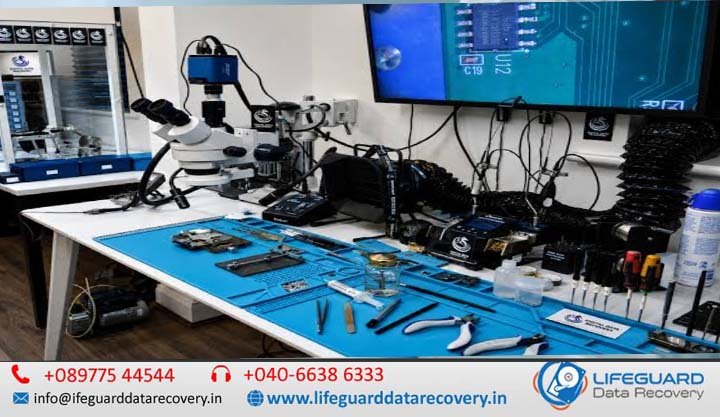
Advanced data recovery laboratory India
Data loss in modern enterprise and consumer environments has evolved far beyond accidental file deletions. As storage density increases, the physical and logical architectures of hard disk drives (HDDs), solid-state drives (SSDs), and redundant arrays of independent disks (RAID) have become immensely complex. When storage media suffers catastrophic mechanical breakdowns, firmware corruption, or electrical destruction, software-based recovery tools fail completely. Evaluating an advanced data recovery laboratory India requires an understanding of technical cleanroom environments, specialized hardware workbenches, and microscopic engineering workflows. This technical guide examines how certified facilities operate, the underlying causes of complex media failure, and how hardware-level data restoration is safely executed. Navigating Complex Data Loss in Modern Storage Systems Modern magnetic and flash-based storage devices are engineered with extreme precision. Mechanical hard drives feature flying head heights measured in nanometers-far smaller than a single dust particle or fingerprint ridge. Solid-state drives employ multi-level flash architecture managed by complex Flash Translation Layer (FTL) algorithms. When physical or structural failure occurs, continuing to supply power to the media frequently leads to permanent, unrecoverable data destruction. A specialized advanced data recovery lab India provides the controlled physical conditions, proprietary hardware tooling, and micro-engineering expertise necessary to bypass damaged controller layers and extract raw binary data safely. What Defines an Advanced High-Tech Data Recovery Laboratory in India? A true professional data recovery laboratory India is not a standard computer repair facility or local IT shop. It is an engineering facility equipped with specialized environmental controls, diagnostic hardware suites, and cryptographic security protocols designed specifically for compromised storage media. Cleanroom Infrastructure: Class 100 / ISO 5 Standards Explained Opening a hard disk drive outside a controlled environment immediately compromises the magnetic platters. An airborne dust particle settling on a platter acts like a boulder when the read/write head passes over it at 7,200 RPM, causing severe rotational abrasion and platter scratching. A legitimate certified data recovery lab India operates an ISO 5 (Class 100) cleanroom or vertical laminar airflow workstation. Air Purity Standard: An ISO 5 environment ensures that air contains no more than 100 particles of size 0.5 microns or larger per cubic foot of air. Laminar Airflow Mechanism: Ultra-low particulate air (ULPA) or High-Efficiency Particulate Air (HEPA) filters continuously scrub ambient air, forcing a uniform stream of purified air downward over the workbench at constant velocity to push contaminants away from exposed drive platters. Static Control: ESD (Electrostatic Discharge) grounded mats, ionized air blowers, and conductive wrist straps prevent static charges from frying delicate drive PCB micro-components. For severe mechanical failures, utilizing verified cleanroom data recovery protocols is the only method to prevent immediate platter scoring during repair operations. Specialized Hardware & Firmware Repair Tools Standard operating systems cannot communicate with failing storage hardware because drive controllers freeze when encountering physical read errors. A high-tech data recovery laboratory relies on dedicated hardware-software suites: ACE Lab PC-3000 Systems: The industry-standard diagnostic and repair ecosystem (PC-3000 Express, UDMA, Portable, and SAS) capable of communicating with storage devices in factory utility modes. It allows engineers to patch drive microcode, bypass system areas, and read drive platters directly. DeepSpar Disk Imagers (DDI): Hardware-assisted drive imaging tools that bypass operating system driver layers. They manage unstable read heads, adjust time-out thresholds, and disable active background routines to build a byte-level clone without stressing damaged media. Micro-Soldering Workstations: Hot-air rework stations, high-frequency oscilloscopes, and digital microscopes used for repairing burned Printed Circuit Boards (PCBs), swapping broken BIOS/ROM microchips, and performing chip-off NAND extractions. Root Causes: When Does Data Loss Require Specialized Laboratory Recovery? Understanding the primary physical and logical failure modes helps determine whether media requires specialized specialized data recovery services India or basic file reconstruction. Storage Architecture Primary Physical/Hardware Failure Mode Specialized Lab Recovery Technique Required Mechanical HDD Head Stack Assembly (HSA) crash, spindle motor seizure Class 100 HSA donor swap, platter transposer swap Mechanical HDD System Area (SA) / Microcode corruption PC-3000 SA track utility patching, translator rebuild SSD / NVMe Flash Translation Layer (FTL) corruption Controller bypass, raw NAND chip-off extraction & descrambling RAID / NAS Arrays Multi-drive controller failure, degraded array configuration Independent drive sector cloning, virtual RAID parameter reconstruction Physical and Mechanical Storage Failures Mechanical hard drives consist of rapidly spinning aluminum or glass platters coated with a thin ferromagnetic layer. When mechanical components fail, physical intervention inside a cleanroom is mandatory. Head Stack Assembly (HSA) Crash: Physical contact between the slider and the platter surface, often caused by drop impact or power surges, leading to bent slider arms or torn magnetic read elements. Spindle Motor Seizure: Fluid Dynamic Bearings (FDB) lock up due to physical impact or heat overload, preventing platters from reaching operational RPM. PCB Component Burnout: Transient voltage spikes destroy TVS diodes, motor controller ICs, or main controller chips, rendering the drive completely unpowered. When a drive experiences severe hardware failure, cleanroom hard drive recovery ensures the mechanical assembly can be stabilized long enough to create a sector-by-sector clone. Firmware Corruption & NAND Flash Controller Failures Solid-State Drives (SSDs) contain no moving parts, but their failure modes are uniquely technical. SSD Controller Lockup: When NAND flash memory cells degrade past their endurance limits, the drive controller’s internal Flash Translation Layer (FTL) becomes corrupted. The drive enters a locked state (often reporting incorrect capacity like 20MB or showing up as “Panic Mode”). HDD System Area (SA) Corruption: Hard drives store critical operation parameters—such as defect lists (P-list/G-list), head alignment maps, and adaptive data—on reserved tracks of the platter known as the System Area. If SA modules become corrupted, the drive will fail to initialize or hang upon boot. Accessing these hidden internal structures requires an expert SSD data recovery laboratory India equipped with direct memory access hardware. Complex Logical and File System Corruption Logical failure occurs when the physical drive functions perfectly, but the data structures stored on it become unreadable. File System Metadata Destruction: Severe damage to NTFS Master File Tables (MFT), APFS B-Trees, or ext4 inodes caused by improper dismounting or power loss. Formatted & Overwritten