
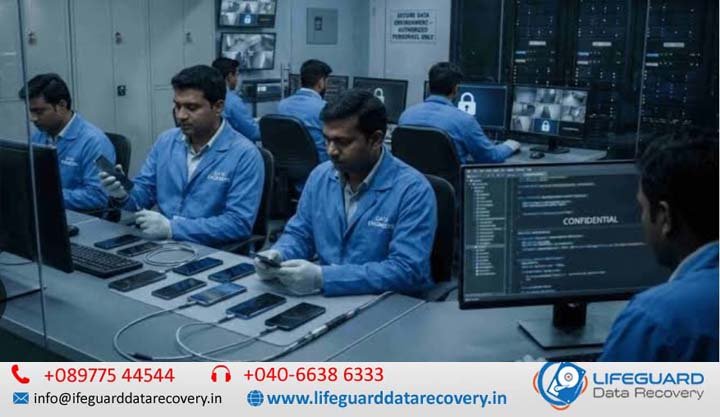
Data recovery assessment India
Unexpected storage failure-whether on a personal laptop, enterprise server, or external backup drive-triggers immediate panic. However, jumping straight into recovery attempts without a proper data recovery assessment in India often transforms temporary data loss into permanent destruction. Diagnostic assessment serves as the medical triage of computer storage: it pinpoints exact failure modes, evaluates platter or chip integrity, and establishes a safe roadmap for extraction before any write operations occur. Understanding how technical evaluations work empowers individuals and IT managers across India to navigate laboratory inspections, evaluate diagnostic reports accurately, and avoid costly mistakes. Navigating Storage Diagnostics in India The Critical Role of Initial Triage in Data Loss When a hard drive or SSD malfunctions, the initial steps determine the survival rate of the trapped files. Running unverified DIY repair software on a mechanically failing drive can strip magnetic platters of their read/write layer within minutes. A structured drive health and data recovery assessment establishes a controlled testing environment, isolating the storage device using hardware write-blockers and specialized power supplies to evaluate physical, firmware, and logical health without subjecting the media to further stress. What You Will Learn from This Guide This comprehensive guide breaks down how laboratory engineers perform a professional data recovery assessment in India. You will learn about: The technical differences between logical, firmware, and physical failures. Specialized diagnostic procedures for HDDs versus NV Me/SATA SSDs. Cleanroom standards, pricing models, and data security under India’s Digital Personal Data Protection (DPDP) Act. How to evaluate diagnostic reports and determine whether data recovery is financially and technically viable. Understanding Data Recovery Assessment Services India: What Is It and Why Is It Necessary? Defining Technical Evaluation vs. Software Recovery Many users conflate basic file undelete software with professional diagnostic services. Standard software utilities operate under the assumption that the storage hardware functions perfectly and can handle continuous read/write cycles. In contrast, data recovery assessment services India utilize specialized hardware-software suites (such as PC-3000 systems) to bypass standard operating system commands. Diagnostic technicians interact directly with drive microcontrollers to read diagnostic registers, inspect primary defect lists (P-list/G-list), and analyze raw sector access without mounting file systems. The Triage Philosophy: Logical, Firmware, and Physical Evaluation A thorough evaluation categorizes failure into three primary branches: Logical Diagnostics: Scans partition structures, Master File Tables (MFT), and file headers when hardware remains fully operational. Firmware Diagnostics: Examines microcode stored on reserved disk sectors or EEPROM chips that allow the drive to initialize and identify itself to the host BIOS/UEFI. Physical Diagnostics: Inspects electrical printed circuit boards (PCBs), read/write head assemblies (HSA), spindle motors, and internal platter surfaces. Risk Mitigation: Preventing Permanent Data Destruction During Inspection The primary goal of data loss diagnosis services India is risk mitigation. When a degraded drive is connected to a standard PC, the operating system automatically attempts to repair file structures via background utilities (like chkdsk or fsck). These automated utilities write changes directly to damaged sectors, permanently overwriting critical file pointers. A formal assessment prevents all host-level interaction through hardware write-blockers. Common Causes of Data Loss Requiring Data Recovery Diagnosis India Mechanical and Physical Disruptions in Spinning Drives Traditional Hard Disk Drives (HDDs) rely on mechanical components operating at tolerances measured in nanometers. Common physical failure vectors requiring a data recovery diagnosis India include: Head Crash: Read/write heads make physical contact with spinning magnetic platters, generating microscopic debris and scraping data tracks. Spindle Motor Seizure: Fluid Dynamic Bearings (FDB) lock up due to physical drops or thermal stress, preventing platter rotation. PCB Electrical Burnout: Power surges or incorrect adapter voltage destroy TVS diodes and motor driver ICs on the external board. Electrical and Firmware Degradation in Solid-State Media Solid-State Drives (SSDs) lack moving parts but introduce complex electronic failure modes requiring specialized SSD failure diagnosis India: Controller Firmware Corruption: The internal controller fails to load its translation table, rendering NAND flash blocks unreadable (often manifesting as a drive showing incorrect capacity, such as 20 MB or generic controller names). NAND Flash Degradation: Microscopic floating-gate transistors exhaust write cycles, leading to corrupt bit-cells and widespread bad blocks. Power Loss Protection (PLP) Failure: Sudden power loss disrupts write operations, corrupting internal metadata mapping tables. Logical Corruption, Ransomware, and File System Damages Even hardware in pristine condition requires a corrupted drive assessment India when logical layer damage occurs: File System Raw Transformation: Corruption of NTFS, ext4, or APFS superblock structures turns partitions into unreadable “RAW” space. Malicious Encryption: Ransomware scrambles file structures, requiring an evaluation of whether shadow copies, unallocated space fragments, or decryption keys exist. Warning Signs and Symptoms That Call for a Data Recovery Inspection India Auditory Indicators of Mechanical Hard Drive Failure Physical hard drives communicate distress through distinct acoustic patterns: Clicking / Ticking (Rhythmic): Indicates the read/write heads are attempting to locate firmware microcode on the platters, failing, and sweeping back to the parking zone. Grinding or Scraping: Signals active head-to-platter contact. Immediate shutdown is mandatory to prevent complete media destruction. High-Pitch Whining: Points to a seized motor spindle or misaligned bearing assembly. System and OS Recognition Anomalies Extreme OS Latency: Windows File Explorer or Mac Finder freezes immediately upon connecting the drive. Uninitialized / RAW Status: Disk Management identifies the volume as “Not Initialized” or prompts for formatting before use. Incorrect Capacity Reporting: The drive identifies in system BIOS under factory default names (e.g., “SATA Device”) with zero or minimal capacity. Silent SSD Failures: Read-Only States and Controller Disappearance Unlike HDDs that emit auditory warnings, SSDs fail silently. Key indicators prompting an immediate data recovery inspection India include: The drive suddenly locks into read-only mode, permitting file copying but rejecting all new writes. The device disconnects mid-operation and fails to re-enumerate until a cold power cycle occurs. The system fails to boot, hanging indefinitely at the motherboard POST splash screen. Step-by-Step Breakdown of a Professional Data Recovery Assessment India Understanding the formal pipeline of a professional data recovery assessment India helps set realistic expectations for diagnostic outcomes. Intake Protocol and Visual Inspection Upon arrival at the laboratory,