
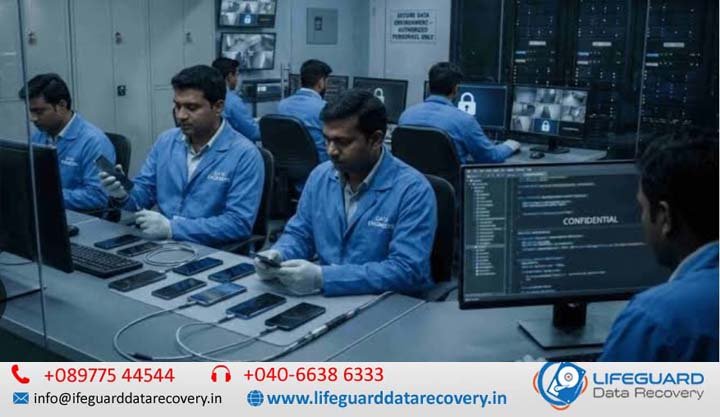
Unexpected storage failure-whether on a personal laptop, enterprise server, or external backup drive-triggers immediate panic. However, jumping straight into recovery attempts without a proper data recovery assessment in India often transforms temporary data loss into permanent destruction. Diagnostic assessment serves as the medical triage of computer storage: it pinpoints exact failure modes, evaluates platter or chip integrity, and establishes a safe roadmap for extraction before any write operations occur.
Understanding how technical evaluations work empowers individuals and IT managers across India to navigate laboratory inspections, evaluate diagnostic reports accurately, and avoid costly mistakes.
Navigating Storage Diagnostics in India
The Critical Role of Initial Triage in Data Loss
When a hard drive or SSD malfunctions, the initial steps determine the survival rate of the trapped files. Running unverified DIY repair software on a mechanically failing drive can strip magnetic platters of their read/write layer within minutes. A structured drive health and data recovery assessment establishes a controlled testing environment, isolating the storage device using hardware write-blockers and specialized power supplies to evaluate physical, firmware, and logical health without subjecting the media to further stress.
What You Will Learn from This Guide
This comprehensive guide breaks down how laboratory engineers perform a professional data recovery assessment in India. You will learn about:
-
The technical differences between logical, firmware, and physical failures.
-
Specialized diagnostic procedures for HDDs versus NV Me/SATA SSDs.
-
Cleanroom standards, pricing models, and data security under India’s Digital Personal Data Protection (DPDP) Act.
-
How to evaluate diagnostic reports and determine whether data recovery is financially and technically viable.
Understanding Data Recovery Assessment Services India: What Is It and Why Is It Necessary?
Defining Technical Evaluation vs. Software Recovery
Many users conflate basic file undelete software with professional diagnostic services. Standard software utilities operate under the assumption that the storage hardware functions perfectly and can handle continuous read/write cycles.
In contrast, data recovery assessment services India utilize specialized hardware-software suites (such as PC-3000 systems) to bypass standard operating system commands. Diagnostic technicians interact directly with drive microcontrollers to read diagnostic registers, inspect primary defect lists (P-list/G-list), and analyze raw sector access without mounting file systems.
The Triage Philosophy: Logical, Firmware, and Physical Evaluation
A thorough evaluation categorizes failure into three primary branches:
-
Logical Diagnostics: Scans partition structures, Master File Tables (MFT), and file headers when hardware remains fully operational.
-
Firmware Diagnostics: Examines microcode stored on reserved disk sectors or EEPROM chips that allow the drive to initialize and identify itself to the host BIOS/UEFI.
-
Physical Diagnostics: Inspects electrical printed circuit boards (PCBs), read/write head assemblies (HSA), spindle motors, and internal platter surfaces.
Risk Mitigation: Preventing Permanent Data Destruction During Inspection
The primary goal of data loss diagnosis services India is risk mitigation. When a degraded drive is connected to a standard PC, the operating system automatically attempts to repair file structures via background utilities (like chkdsk or fsck). These automated utilities write changes directly to damaged sectors, permanently overwriting critical file pointers. A formal assessment prevents all host-level interaction through hardware write-blockers.
Common Causes of Data Loss Requiring Data Recovery Diagnosis India
Mechanical and Physical Disruptions in Spinning Drives
Traditional Hard Disk Drives (HDDs) rely on mechanical components operating at tolerances measured in nanometers. Common physical failure vectors requiring a data recovery diagnosis India include:
-
Head Crash: Read/write heads make physical contact with spinning magnetic platters, generating microscopic debris and scraping data tracks.
-
Spindle Motor Seizure: Fluid Dynamic Bearings (FDB) lock up due to physical drops or thermal stress, preventing platter rotation.
-
PCB Electrical Burnout: Power surges or incorrect adapter voltage destroy TVS diodes and motor driver ICs on the external board.
Electrical and Firmware Degradation in Solid-State Media
Solid-State Drives (SSDs) lack moving parts but introduce complex electronic failure modes requiring specialized SSD failure diagnosis India:
-
Controller Firmware Corruption: The internal controller fails to load its translation table, rendering NAND flash blocks unreadable (often manifesting as a drive showing incorrect capacity, such as 20 MB or generic controller names).
-
NAND Flash Degradation: Microscopic floating-gate transistors exhaust write cycles, leading to corrupt bit-cells and widespread bad blocks.
-
Power Loss Protection (PLP) Failure: Sudden power loss disrupts write operations, corrupting internal metadata mapping tables.
Logical Corruption, Ransomware, and File System Damages
Even hardware in pristine condition requires a corrupted drive assessment India when logical layer damage occurs:
-
File System Raw Transformation: Corruption of NTFS, ext4, or APFS superblock structures turns partitions into unreadable “RAW” space.
-
Malicious Encryption: Ransomware scrambles file structures, requiring an evaluation of whether shadow copies, unallocated space fragments, or decryption keys exist.
Warning Signs and Symptoms That Call for a Data Recovery Inspection India
Auditory Indicators of Mechanical Hard Drive Failure
Physical hard drives communicate distress through distinct acoustic patterns:
-
Clicking / Ticking (Rhythmic): Indicates the read/write heads are attempting to locate firmware microcode on the platters, failing, and sweeping back to the parking zone.
-
Grinding or Scraping: Signals active head-to-platter contact. Immediate shutdown is mandatory to prevent complete media destruction.
-
High-Pitch Whining: Points to a seized motor spindle or misaligned bearing assembly.
System and OS Recognition Anomalies
-
Extreme OS Latency: Windows File Explorer or Mac Finder freezes immediately upon connecting the drive.
-
Uninitialized / RAW Status: Disk Management identifies the volume as “Not Initialized” or prompts for formatting before use.
-
Incorrect Capacity Reporting: The drive identifies in system BIOS under factory default names (e.g., “SATA Device”) with zero or minimal capacity.
Silent SSD Failures: Read-Only States and Controller Disappearance
Unlike HDDs that emit auditory warnings, SSDs fail silently. Key indicators prompting an immediate data recovery inspection India include:
-
The drive suddenly locks into read-only mode, permitting file copying but rejecting all new writes.
-
The device disconnects mid-operation and fails to re-enumerate until a cold power cycle occurs.
-
The system fails to boot, hanging indefinitely at the motherboard POST splash screen.
Step-by-Step Breakdown of a Professional Data Recovery Assessment India
Understanding the formal pipeline of a professional data recovery assessment India helps set realistic expectations for diagnostic outcomes.
Intake Protocol and Visual Inspection
Upon arrival at the laboratory, engineers log the serial number and inspect external casings for structural impacts, liquid damage, cracked connectors, and tampered warranty seals. Microscopic checks confirm whether components on the controller board are burnt or short-circuited.
Safe Hardware Isolation and Write-Blocker Attachment
The drive is mounted to dedicated diagnostic hardware controllers rather than standard SATA/USB ports. Hardware write-blockers ensure zero signals pass back to the target media, eliminating accidental overwrites.
Low-Level Firmware Diagnostics via Specialized Hardware Tools
Engineers access the drive’s internal Service Area (SA). They evaluate utility modules containing translator tables, adaptive parameters, and SMART logs. For solid-state drives, engineers enter vendor-specific utility modes (Factory/Safe Mode) to communicate directly with controller microprocessors.
Sector-by-Sector Diagnostic Imaging
Laboratory rules prohibit performing recovery directly on original media. Technicians utilize advanced imaging tools to build a sector-by-sector clone. These tools adaptively adjust read speeds, skip unreadable bad sectors, and isolate problematic heads to maximize data extraction without stressing vulnerable components.
Logical File System Parsing and Integrity Verification
Once an image is created, file system parsers analyze structural pointers, rebuild damaged file directory trees, and verify target file integrity (such as database headers, archive structures, and high-value document formats).
Generating the Diagnostic Report and Data Recovery Estimate
The final phase produces a technical diagnostic report detailing exact file trees, bad sector counts, media condition, and a fixed data recovery estimate after assessment.
Evaluating traditional magnetic storage requires mechanical benchwork, whereas evaluating solid-state drives centers on silicon, microcode, and signal processing.
Hard Drive Evaluation: Cleanroom Benchmarking and Mechanical Inspection
A hard drive data recovery assessment India for physically compromised units takes place inside certified cleanroom environments. Engineers evaluate:
-
Head stack assembly resistance using digital multimeters.
-
Platter surface contamination and microscopic head abrasion.
-
PCB ROM compatibility during donor board swaps to match adaptive alignment settings.
Solid-State Drive Evaluation: NAND Controller and TRIM Command Complexity
An SSD data recovery assessment India focuses heavily on firmware microcode state and TRIM behavior:
-
TRIM Protocol Handling: If the operating system issues a TRIM command after file deletion or formatting, the SSD controller clears logical-to-physical mapping tables. Diagnostics verify whether raw NAND pages still contain data blocks or if garbage collection has zeroed out the cells.
-
Technique Determination: Diagnosticians decide between controller-level firmware repair or direct “Chip-Off” extraction, where individual NAND chips are desoldered, read via raw flash programmers, and algorithmically re-assembled to emulate the original controller configuration.
Comparative Diagnostic Matrix: HDD vs. SSD Assessment
| Evaluation Parameter | Hard Disk Drive (HDD) Assessment | Solid-State Drive (SSD) Assessment |
| Primary Failure Vectors | Head crash, motor failure, bad sectors, firmware module corruption | NAND wear-out, controller corruption, power loss protection failure |
| Diagnostic Environment | Cleanroom Class 100 / ISO 5 (for internal inspection) | ESD-safe electronic bench with micro-soldering stations |
| Primary Equipment | PC-3000 SAS/SATA, Head Replacement Jigs, Microscope | PC-3000 Flash/SSD, NAND Readers, Hot Air Rework Stations |
| Impact of TRIM | None (deleted sectors remain until overwritten) | High (TRIM can zero out block tables almost instantaneously) |
| Assessment Complexity | Moderate to High (mechanical precision reliant) | Very High (reverse-engineering complex controller algorithms) |
| Average Diagnostic Time | 24 – 48 Hours | 24 – 72 Hours |
Laboratory Protocols and Tooling in a Data Recovery Lab Assessment India
Cleanroom Workstations: ISO 5 / Class 100 Standards Explained
During a data recovery lab assessment India, opening a mechanical hard drive outside an ultra-clean environment introduces airborne dust particles onto platters. At high rotational speeds (5400 to 15000 RPM), a single dust particle acts as an immovable wall, causing immediate head crashes. Certified ISO 5 (Class 100) clean benches utilize High-Efficiency Particulate Air (HEPA) filters to maintain less than 100 particles ($\ge 0.5 \mu m$) per cubic foot of air.
Specialized Hardware and Software Tools Utilized by Engineers
Leading laboratories in India deploy dedicated utility hardware suites:
-
Hardware Diagnostic Systems: ACE Lab PC-3000 Express/Portable for deep firmware editing and sector-level imaging.
-
Precision Mechanical Jigs: Custom head-swapping tools designed for specific drive families (Seagate, Western Digital, Toshiba).
-
Thermal Imaging Cameras: Used to detect short-circuits and overheating power ICs on controller boards.
Data Privacy, NDA, and DPDP Act 2023 Compliance in Indian Labs
Handling sensitive corporate databases or personal records requires strict legal and technical compliance:
-
Digital Personal Data Protection (DPDP) Act 2023: Indian recovery centers must adhere to statutory requirements regarding user data consent, secure handling, and mandatory erasure post-recovery.
-
Non-Disclosure Agreements (NDAs): Formal assessment workflows include legally binding NDAs protecting client confidentiality.
-
Air-Gapped Workstations: Storage imaging networks operate completely isolated from the internet to prevent data leakage or external cyber threats during analysis.
What to Expect During a Data Recovery Consultation India and Data Recovery Analysis India
Free vs. Paid Diagnostic Assessment: Reading Between the Lines
When evaluating a free data recovery assessment India, it is crucial to understand what is included:
-
Standard Free Diagnostics: Generally covers non-invasive software checks, external PCB testing, and initial firmware queries.
-
Paid / Bench-Fee Diagnostics: Applies to media requiring invasive cleanroom teardowns, microscopic solder work, or donor parts allocation just to perform the initial evaluation. Transparent service providers outline potential bench charges before opening a drive.
Interpreting the Diagnostic Report: File Tree, Bad Sectors, and Recovery Feasibility
A comprehensive data recovery analysis India report delivers clear, actionable metrics rather than vague promises:
-
Target File List & Condition: Interactive file trees highlighting fully intact, partially corrupted, or unrecoverable files.
-
Sector Map Analysis: Percentage breakdown of green (readable), yellow (slow reading), and red (damaged/bad) sectors across drive space.
-
Data Recovery Possibility Assessment: Objective percentage rating (e.g., 95% feasibility) based on head stability and structural file system integrity.
Red Flags to Avoid When Selecting a Diagnostic Provider
-
Guaranteed 100% Success Rates: No legitimate lab can guarantee full recovery prior to completing a physical and firmware analysis.
-
Refusal to Provide Diagnostic Reports: Avoid providers who give flat price quotes over the phone without inspecting the physical drive.
-
Lack of Physical Address or Cleanroom Facilities: Unverified entities acting as middlemen often outsource drives, adding transit risks.
Key Factors in Data Recovery Case Evaluation India and Data Recovery Evaluation India
Determining the ROI: When Is Recovery Worth the Investment?
A structured data recovery case evaluation India helps clients calculate financial and operational feasibility:
-
Business Data: Weigh recovery costs against business downtime, legal compliance penalties, lost customer records, or the cost of manually recreating files.
-
Personal Data: Determine sentimental value (family photos, personal archives) against repair costs.
Industry-Standard Pricing Ranges Post-Assessment in India
Reputable data recovery providers in India establish pricing based on technical complexity determined during diagnosis, rather than volume of data requested:
| Failure Category | Diagnostic Complexity | Typical Price Range (INR)* | Key Technical Dependencies |
| Logical Failure | Low / Medium | ₹3,000 – ₹9,000 | Intact hardware; directory structure rebuilds required |
| Firmware / PCB Damage | Medium | ₹8,000 – ₹18,000 | Firmware patch, ROM transfer, component-level repair |
| Complex Physical / Mechanical | High | ₹15,000 – ₹45,000+ | Class 100 cleanroom, donor head replacement, platter swap |
| SSD Controller / NAND Flash | High / Extreme | ₹12,000 – ₹40,000+ | Custom pinout identification, NAND chip-off reassembly |
Estimates represent standard market averages across major Indian metro hubs (Bengaluru, Mumbai, Delhi-NCR, Hyderabad) and vary based on media capacity and severity.
Turnaround Time Standards: Standard vs. Emergency Evaluation
-
Standard Assessment: Completed within 24 to 48 hours; ideal for non-critical failures.
-
Priority / Emergency Assessment: Completed within 4 to 12 hours utilizing dedicated hardware suites around the clock for time-sensitive corporate environments.
Best Practices and Prevention Tips to Avoid Emergency Recovery Assessments
Implementing the 3-2-1 Backup Rule for Personal and Business Data
The most effective way to eliminate emergency recovery costs is strict backup discipline:
-
Maintain 3 total copies of critical data.
-
Store data across 2 different storage media types (e.g., internal NVMe SSD + external HDD or NAS).
-
Keep 1 copy completely offsite or in secure cloud storage.
Proactive Storage Health Monitoring (S.M.A.R.T. Telemetry)
Monitor your drive’s internal Self-Monitoring, Analysis, and Reporting Technology (S.M.A.R.T.) indicators using utilities like Crystal Disk Info or smart moon tools. Pay close attention to:
-
Reallocated Sectors Count: Indicates physical sector degradation.
-
Current Pending Sector Count: Identifies unstable sectors awaiting reallocation.
-
SSD Media Wear out Indicator: Tracks remaining flash cell life percentage.
Safe Media Handling During Early Signs of Drive Distress
If a drive exhibits performance drops or unusual noises:
-
Unplug the device immediately. Do not attempt rebooting or reconnecting multiple times.
-
Avoid running built-in disk repair commands (
chkdsk,fsck). -
Never open the hard drive casing outside a cleanroom environment.
-
Contact a laboratory specializing in physically damaged hard drive assessment immediately.
Frequently Asked Questions About Data Recovery Assessment in India
How long does a typical data recovery assessment take in India?
A standard data recovery assessment in India takes between 24 and 48 hours. Complex cases involving damaged SSD controllers or severely scratched mechanical platters may take up to 72 hours to complete full sector imaging tests.
Can data be recovered if the hard drive is clicking or physically damaged?
Yes, clicking drives can frequently be recovered, but only if power is disconnected immediately. Clicking indicates read/write head failure. Recovery engineers replace the damaged head assembly inside a Class 100 cleanroom before performing sector-by-sector cloning.
What is the difference between a free evaluation and a paid cleanroom diagnosis?
A free evaluation covers non-invasive software, electrical, and surface-level checks. A paid cleanroom diagnosis typically applies when a drive requires physical disassembly, donor parts allocation, or micro-soldering work to determine recovery feasibility.
Is my data safe during the laboratory diagnostic assessment?
Reputable laboratories follow ISO 27001 data security procedures and comply with India’s Digital Personal Data Protection (DPDP) Act 2023. Drive assessments are conducted on air-gapped workstations using hardware write-blockers, ensuring your original data remains unchanged and confidential.
What happens if the assessment reveals the drive is unrecoverable?
If the diagnostic analysis reveals complete media destruction (such as severe platter magnet layer stripping), reputable labs return the drive without charging recovery fees. Optional secure media destruction services are also available upon request.