
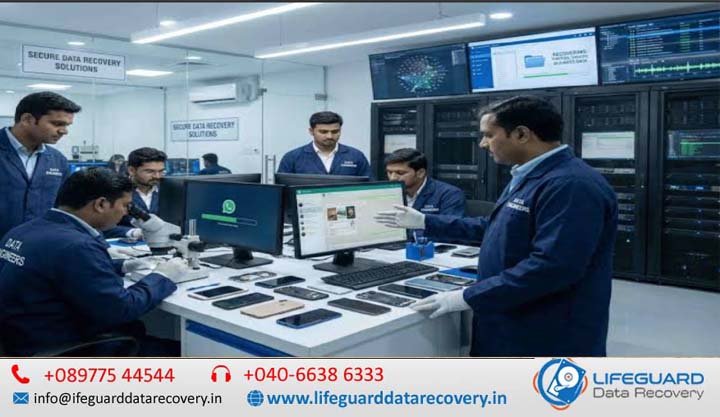
Data recovery diagnosis service India
Experiencing sudden storage failure can cause immediate friction, whether it involves mission-critical corporate databases, personal financial archives, or sensitive legal records. When a hard drive, solid-state drive (SSD), or RAID array stops responding, the instinct to run immediate recovery software or repeatedly power-cycle the drive is strong. However, skipping a formal data recovery assessment in India often transforms a recoverable media issue into permanent data destruction. Professional laboratory testing acts as your critical first line of defense. Understanding how data recovery diagnosis works helps individuals and enterprises understand that true diagnosis is a non-destructive evaluation process. It isolates mechanical, logical, electronic, and firmware issues without altering the original sectors of the storage media. The High Risk of Immediate DIY Recovery Attempts Commercial recovery utilities are engineered under the assumption that the target drive is physically healthy. When applied to media with severe bad sectors, failing read/write heads, or degrading flash controllers, DIY software forces the drive to read unreadable sectors repeatedly. This continuous friction can score magnetic platters, strip media coatings, or trigger flash controller panic locks. A laboratory evaluation eliminates this gamble by placing the media on specialized diagnostic hardware that operates in a safe, read-only environment. What You Will Learn from a Professional Data Recovery Assessment This comprehensive guide breaks down every aspect of a laboratory diagnosis. You will learn how engineers evaluate complex media failures, what equipment is required to preserve drive integrity, how to decode a diagnostic feasibility report, and how to select a certified data recovery facility operating under strict privacy standards in India. What is a Storage Device Diagnostic Service India? A storage device diagnostic service in India is a specialized laboratory procedure that evaluates damaged, corrupted, or unresponsive storage media to determine the exact root cause of failure, assess data feasibility, and calculate a transparent recovery timeline. Unlike general computer repair shops that rely on basic operating system utilities or third-party scanning software, a professional data recovery lab diagnosis in India employs specialized hardware-software complexes-such as ACE Lab PC-3000-to communicate directly with drive microcode without mounting file systems. Logical vs. Physical Data Recovery Diagnosis India To understand a data recovery diagnosis in India, it is vital to separate logical corruption from physical hardware damage: Logical Diagnostics: Analyzes damage to file structures, Master File Tables (MFT), partition tables, volume boot records, or accidental formatting while the underlying storage hardware remains 100% healthy. Physical Diagnostics: Inspects electrical printed circuit boards (PCB), micro-actuator head stack assemblies (HSA), spindle motors, magnetic platter surfaces, and NAND flash controllers inside a controlled environment. Software Assessment vs. Data Recovery Lab Diagnosis India Standard operating systems (Windows, macOS, Linux) constantly attempt to auto-repair unreadable drives using background services like CHKDSK or fsck. These background operations overwrite raw metadata, making recovery infinitely more difficult. Conversely, specialized laboratory diagnostics bypass the native operating system entirely, utilizing hardware controllers that block write signals to preserve the drive’s exact state. Why Storage Drives Fail: Root Causes Requiring Data Recovery Analysis Service Different storage technologies exhibit completely distinct failure vectors. A dedicated data recovery analysis service evaluates media based on its architectural design. Mechanical & Physical Media Failure (HDD Data Recovery Assessment India) A detailed HDD data recovery assessment in India checks mechanical components operating within microscopic tolerances. Head Assembly Failure: Read/write heads hover nanometers above spinning magnetic platters. Power surges or physical drops cause heads to contact the surface, leading to severe media scratch damage. System Area (SA) / Service Area Firmware Corruption: Hard drives store critical operating parameters (translator tables, defect lists like P-list and G-list) on reserved platter sectors. If the SA becomes unreadable, the drive will fail to initialize or show incorrect capacity. Spindle Motor Seizure: Thermal stress or drop impacts can bend fluid dynamic bearings (FDB), locking the motor and preventing disk spin. Controller & Firmware Degradation (SSD Data Recovery Diagnosis India) Executing an SSD data recovery diagnosis in India requires an entirely different methodology compared to mechanical drives. SSDs have no moving parts, but their complexity lies in flash management algorithms. Flash Translation Layer (FTL) Corruption: SSD controllers map logical block addresses (LBA) to physical NAND flash addresses. If the FTL corrupts due to sudden power loss, the drive enters a “panic mode” (often reporting standard factory sizes like 2MB or remaining unmapped). NAND Flash Wear & Bit Rot: Individual flash memory cells degrade over write cycles. When error-correcting code (ECC) capabilities are exceeded, data blocks become unreadable, triggering controller failure. Array Desynchronization & Failure (RAID & NAS Case Evaluation) For enterprise data centers and network-attached storage (NAS) devices, diagnosis centers on multi-drive synchronization. Diagnostic tools reconstruct missing parity, identify out-of-sync member drives, and emulate hardware RAID controller parameters virtually before reading raw array volumes. Signs Your Storage Needs a Professional Data Recovery Assessment Immediately Recognizing critical failure indicators allows you to request a professional data recovery assessment before complete hardware failure occurs. Mechanical Symptoms: Clicking, Grinding, and Beeping Drives Physical noise is the most definitive indicator that you require professional diagnosis for inaccessible hard drives. Repeated Rhythmic Clicking (Click of Death): Indicates the drive controller is attempting to position damaged or uncalibrated read/write heads over the microcode tracks, failing, and sweeping back to the landing zone. High-Pitched Whining or Buzzing: Indicates a seized spindle motor attempting to turn jammed magnetic platters. Grinding or Scraping: Indicates active platter contact where read/write heads strip magnetic substrate off the disk. Power off the drive immediately if this sound occurs. Logical & Electronic Symptoms: Unrecognized Drives, RAW File Systems, and OS Freezes Even without physical noise, internal drive corruption presents clear warning signs: The drive mounts as “RAW” in Windows Disk Management or prompts an immediate format dialog. File structures return I/O device errors, CRC (Cyclic Redundancy Check) failures, or deep system freezes upon connection. The device manager identifies the drive controller chip (e.g., “SATA Device”) but displays 0 Bytes total capacity. Step-by-Step Workflow: How a Data Recovery Evaluation Service India Operates A certified data recovery evaluation service in India follows a