
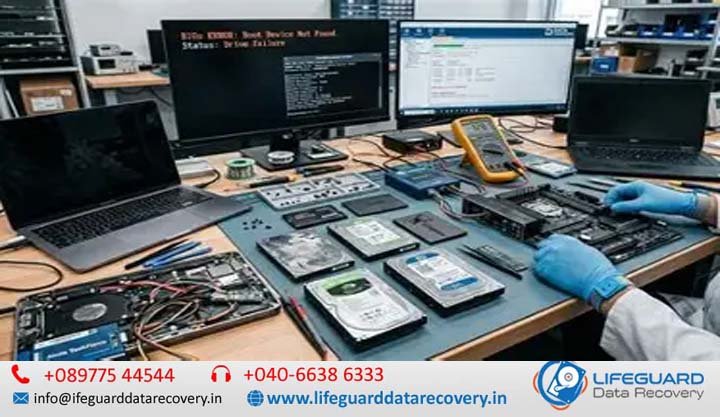
HDD BIOS detection failure recovery India
When a computer fails to boot or an secondary drive disappears, few technical issues cause as much anxiety as a hard disk drive (HDD) vanishing from the BIOS/UEFI. The Basic Input/Output System (BIOS) acts as the low-level handshake between your motherboard and storage media. If your drive isn’t listed during POST (Power-On Self-Test), your operating system cannot load, and your files become completely inaccessible. In India, storage drives face unique environmental and operational challenges-from voltage spikes caused by unannounced power outages to elevated ambient humidity and dust exposure. Resolving an HDD BIOS detection failure recovery India scenario requires a structured approach that separates simple cable or software settings from dangerous hardware failures. Introduction: What Happens When Your Hard Drive Disappears from BIOS? When an HDD not detected in BIOS error occurs, the primary diagnostic system on your motherboard has sent an identification command down the SATA or NVMe bus and received either silence, corrupt data, or an electrical short error. How BIOS Interacts with Your Hard Disk Drive During system startup, the BIOS queries all physical storage controllers via standard SATA/AHCI protocols. The drive’s on-board controller (PCB) responds by transmitting its firmware identification, serial number, head configuration, and sector capacity. If electrical power is missing, the PCB logic board is burned, or the internal read/write heads fail to read the platter’s Service Area (SA), the BIOS marks the port as “Empty” or “Not Present”. Quick Triage: Safe DIY vs. Immediate Professional Recovery Before attempting any troubleshooting step, perform a quick safety evaluation: Symptom / Condition Risk Level Safe DIY Action? Recommended Next Step Silent drive, normal BIOS settings Low Yes Reseat cables, check secondary PC. Drive spins smoothly, not in BIOS Moderate Yes (Limited) Check BIOS storage mode, update IRST drivers. Burnt smell or visible PCB scorch High No Do not power on; requires [hard drive data recovery India] service. Clicking, grinding, or loud beeping Critical No Shut down immediately; cleanroom mechanical repair required. Key Causes of Hard Drive Detection Failure in India A hard drive detection failure India diagnosis typically falls into one of four distinct technical categories: Physical and Mechanical Failures Inside a hard drive, magnetic platters spin at speeds between 5,400 and 7,200 RPM while read/write heads float nanometers above the surface. HDD head failure: Physical shocks or sudden power loss can cause the floating heads to contact the platter surface or crash into the parking ramp. If the heads cannot read calibration data from the drive, the drive aborts startup and remains unrecognized. HDD spindle motor failure: Spindle motor bearings can seize due to physical impacts or fluid bearing lubricant degradation, leaving the drive completely silent or producing a faint electrical buzz. Electronic and PCB Component Damage Electrical power quality in many Indian cities experiences frequent surge variations and brownouts. HDD PCB failure & HDD electronic failure: A sudden voltage spike often causes the drive’s Transient Voltage Suppressor (TVS) diodes on the 5V or 12V rails to short to ground to shield inner silicon. Hard drive power failure: If a power surge breaches the TVS diode, it destroys the motor control IC or main controller chip, leaving the drive without logic power. Firmware Corruption and Service Area Loss A hard drive’s operating microcode is divided between an 8-pin ROM chip on the outer PCB and a reserved zone on the spinning platters called the Service Area (SA). If HDD firmware failure occurs due to bad sectors in the Service Area, the drive enters a kernel loop. The BIOS will either fail to detect the drive or display corrupted model names with 0 MB capacity. Cable, Port, and Connection Faults Indian atmospheric conditions with high dust index levels accelerate metal oxidation on exposed contacts. SATA cable failure: Internal SATA data cables degrade over time due to thermal cycling and physical bending, leading to packet errors that prevent the BIOS from completing its handshake. HDD power connector problem: Loose SATA power molex splitters or corroded power pins cut off stable voltage, preventing the disk motor from reaching full operational speed. Recognizing the Symptoms: Diagnosing Internal HDD Not Detected Issues Proper diagnosis relies on observing both auditory and visual cues before opening your PC case. Auditory Clues Rhythmic Clicking or Ticking: Indicates the drive controller is attempting to position the read/write heads, but cannot locate alignment marks on the platter surface. High-Pitch Beeping or Whining: Indicates stiction (heads stuck to platters) or a seized spindle motor attempting to rotate. Total Silence: Points directly to an HDD electronic failure or blown TVS diode on the PCB board. BIOS/UEFI Visual Indicators Blank / “Not Present”: The port electrical link is completely inactive. Scrambled Strings: Displays text like BS_35_SATA or random symbols, indicating microcode corruption in the drive’s Service Area. 0 MB Capacity / Uninitialized: The drive controller responds, but the translator module mapping logical blocks is inaccessible. Internal SATA vs. External USB HDD Non-Detection Differences When an internal HDD not detected issue occurs, connection checks focus on direct motherboard ports and SATA PSU cables. For an external HDD not detected problem, the breakdown often resides in the USB-to-SATA bridge controller inside the external casing rather than the drive itself. Removing the bare drive from its enclosure and testing via direct SATA connection often isolates enclosure controller failure. Step-by-Step DIY Fixes for HDD BIOS Detection Failure Follow these steps sequentially to resolve soft detection errors while avoiding data loss. Step 1: Physical Cable & Power Inspections Power down the system completely and switch off the PSU switch. Open the desktop cabinet and disconnect both the SATA data cable and SATA power cable. Inspect gold contacts for oxidation or dust buildup; clean gently with isopropyl alcohol and a soft brush. Plug the SATA data cable into a different port on the motherboard (preferably Ports 0 or 1). Use a direct power cable from the power supply unit rather than daisy-chained molex adapters. Step 2: BIOS/UEFI Configuration & Reset Boot your computer and repeatedly press F2, DEL, or F10 to enter BIOS Setup.